

Context
In shared environments such as offices, canteens, and airports, waste management is rarely a technical problem. It is an economic and behavioral one. Operators pay for waste disposal. Users want convenience. Regulators require measurable recycling performance. Yet most solutions optimize either bin design or classification technology, without addressing how value actually flows through the system.
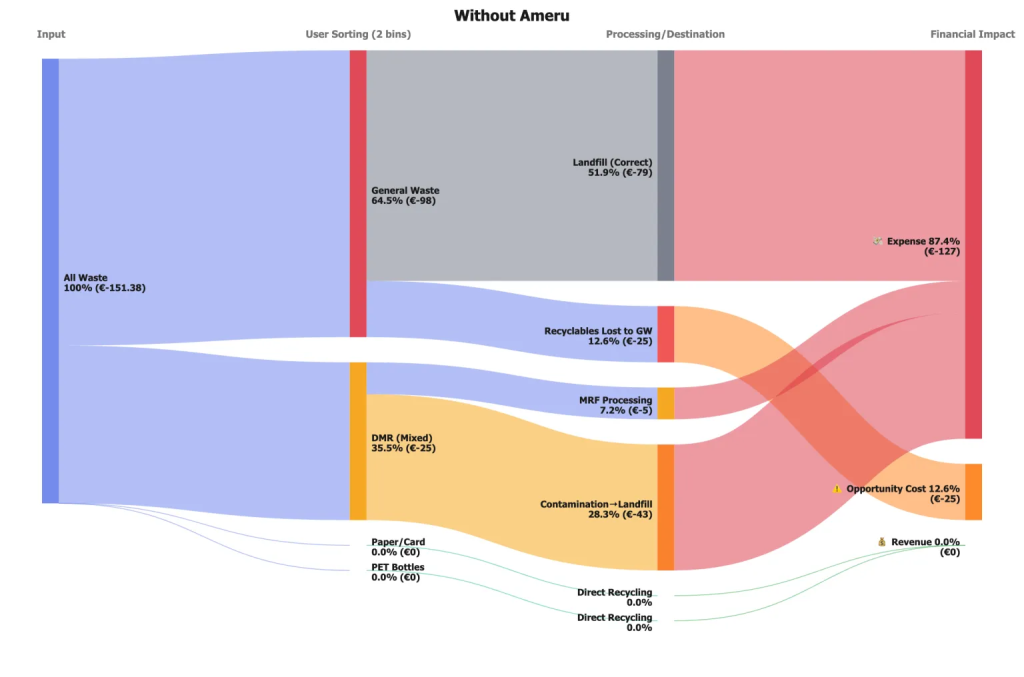
Ameru began by analyzing the full waste-to-value chain. The typical situation shows high general waste share, significant contamination, recyclables lost to landfill, and nearly all financial impact appearing as expense. Revenue from recyclables is effectively zero. The system works, but economically it leaks value. Ameru set out not to improve sorting in isolation, but to correct this leakage structurally.
Value Thinking
Instead of defining success as “better accuracy,” Ameru translated stakeholder needs into differentiated, measurable outcomes. Define Each KPI makes explicit whose problem is being solved and how value is assessed:
| KPI Name | Stakeholder | Value |
|---|---|---|
| Disposal convenience parity | User | Providing a familiar “throw and forget” experience (Qualitative) |
| Reduction in value leakage | Operator | 75% reduction. Recyclables lost to waste reduced from 20% to 5%. |
| Payoff time | Operator | Investment pays off in less than 2.5 years. |
| Recycling Rate | Regulator | Increase recycling rates from ~20% to ~45%, thus reducing CO2-heavy landfill and WtE treatment. |
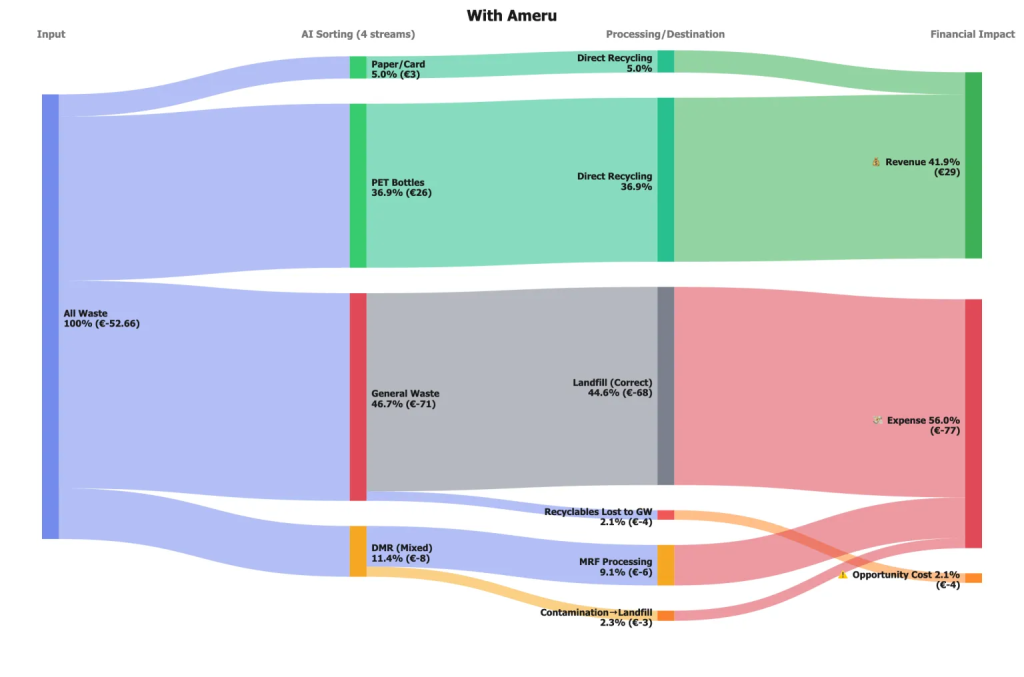
The KPIs reframed the goal: engineer the system to solve the operator’s economic problem, not merely to classify waste more precisely. Most value that once flowed toward landfill expense and lost recyclables is redirected into clean, directly recyclable streams, converting cost into revenue. For the operator (the paying customer) this creates a clear and calculable return on investment.
Close the Loop
Operate Ameru treats deployment as part of the value system rather than the end of development. Monitor Each installed bin produces operational data on waste composition, sorting outcomes, contamination, and economic impact. That data does not flow back as raw telemetry.
Evolve System Stewardship evaluates it against the defined KPIs and transforms it into business-relevant insight, turning “20% recyclables lost” into a quantified economic deviation an operator can act on. Align The structured insight returns to the Business practice, where the product definition is realigned and improvements are targeted where economic impact is highest.
Because value is explicitly quantified, this loop stays closed: monitoring is not an afterthought but a structural capability, and System Stewardship is what keeps design intent and real-world performance connected.
Outcome
By separating stakeholders and quantifying their success criteria, Ameru engineered a solution that addresses the full system:
- Users experience no additional friction.
- Operators reduce waste-related expense and recover material value.
- Regulators see measurable improvement in recycling performance.
The result is structural correction of value leakage. The shift from cost-heavy landfill flows to high-quality recyclable streams transforms waste management from a compliance burden into an economically rational system: one that keeps improving because the loop from operation back to definition stays closed.
 English
 German