
Context
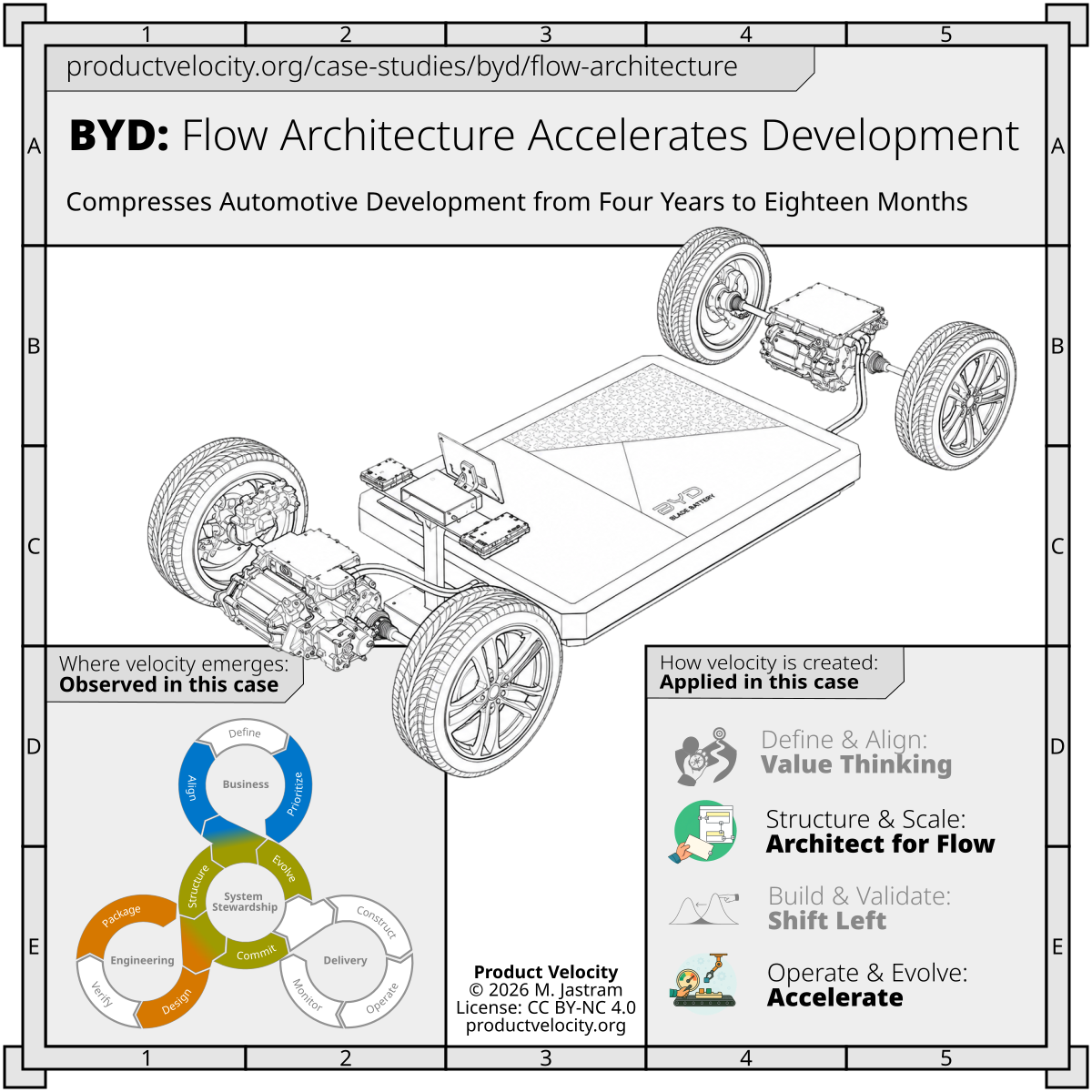
Chinese EV manufacturer BYD has emerged as one of the fastest-moving automotive companies in the world. In a 2023 interview, Executive Vice President Stella Li stated that BYD’s standard vehicle development cycle is 18 months, compared to roughly four years in the traditional automotive industry.
BYD has been around since the 1990s. The company now develops and manufactures batteries, electronics, motors, telematics, thermal systems, and much of the software stack internally. Stella Li summarized the degree of integration bluntly: “except for the tires and the windows, we produce everything in-house.”
“Except for the tires and the windows, we produce everything in-house.”
Stella Li
The result is a development organization with unusually tight coupling between engineering, manufacturing, supply chain, and software delivery.
Architect for Flow
Structure BYD’s operating model reduces the number of organizational and technical interfaces required to bring a vehicle to market. Instead of coordinating large numbers of suppliers across subsystem boundaries, engineering teams work inside a vertically integrated environment with shared ownership of architecture and implementation.
This changes the economics of decision making. Evolve Cross-functional issues are resolved directly between teams rather than escalated through supplier negotiations and contractual interfaces. Commit Stella Li described the process as bringing mechanical and electronics teams “into one room” to solve integration problems collaboratively. The organization behaves less like a traditional OEM and more like an integrated systems company.
BYD also standardized large parts of its EV portfolio around common architectures such as the e-Platform. Package Shared batteries, electronics, thermal systems, and software foundations reduce the scope of redesign required for new vehicle programs. Package Platform reuse localizes change and shortens integration cycles. This mirrors patterns long established in software platform engineering but applied to cyberphysical products at manufacturing scale.
Accelerate
BYD combines architectural integration with unusually high organizational throughput. The company employs massive engineering capacity across batteries, software, electronics, manufacturing, and material science. Align Decisions that traditionally move sequentially across supplier chains instead happen concurrently inside the organization.
Prioritize The Chinese EV market acts as a continuous stress test for responsiveness. Manufacturers face rapid feature competition, aggressive pricing pressure, and compressed refresh cycles. Stella Li repeatedly describes China as “the toughest market.”
“Survival in this environment requires rapid iteration and short feedback loops across the entire development system.”
Stella Li
Outcome
BYD became one of the world’s largest EV manufacturers while simultaneously expanding from affordable vehicles into premium and luxury segments. The company now operates multiple brands targeting different market tiers, including Ocean, Dynasty, Denza, and Yangwang.
More important than individual vehicle launches is the organizational pattern behind them. BYD demonstrates that product development speed in cyberphysical systems is strongly influenced by architecture, organizational interfaces, and feedback latency. The company optimized for integration and flow rather than for local supplier specialization. The resulting capability allows rapid adaptation across engineering, manufacturing, and market requirements simultaneously.
 English
 German