
Context
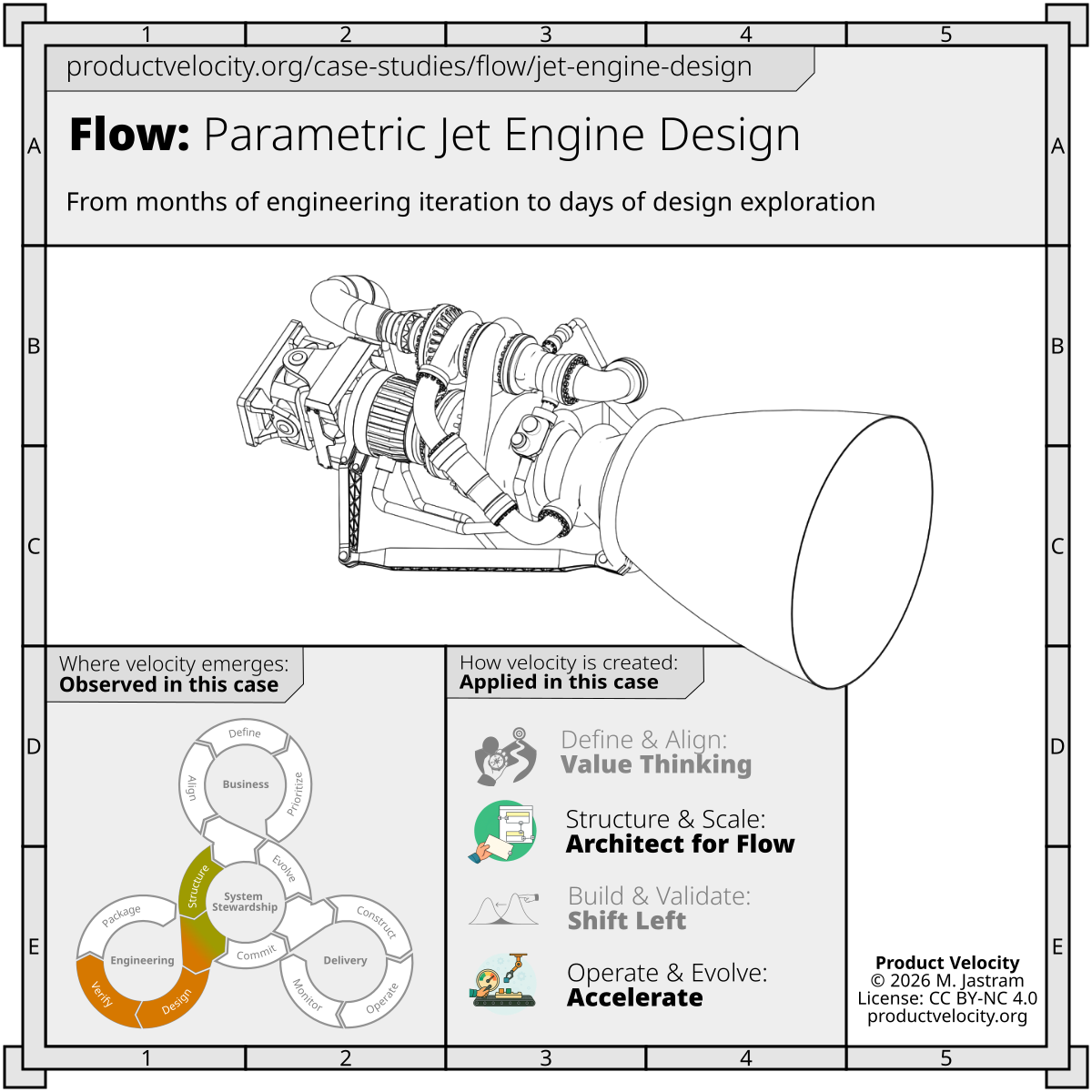
Jet engine design traditionally required long iteration cycles. Engineers changed parameters such as thrust or pressure ratios and then recalculated performance, thermodynamics, and structural implications across many subsystems. Each iteration required coordination across multiple engineering domains and toolchains. Early in the development of Flow Engineering, Pari Singh and his team built a parametric design system using spreadsheets, MATLAB, and Simulink models. Instead of running isolated calculations, engineers described engines through parameters such as thrust, bypass ratio, and turbine temperature. The system propagated these parameters through the engineering models and generated the resulting design analyses.
Architect for Flow
Structure The key innovation was architectural. Instead of organizing engineering work around individual analyses, the team organized the development system around a parametric model that captured the relationships between engine components. Once encoded, these relationships allowed engineers to change parameters and immediately observe system-wide consequences. The model effectively acted as a domain-specific language for jet engines. Engineers expressed design intent using domain concepts, while the system executed the underlying physics calculations. Verify This architecture allowed rapid design exploration across the engineering workflow, connecting design and analysis in a continuous feedback loop.
Accelerate
Design The parametric model enabled automated exploration of the design space. Engineers defined target parameters and constraints, and the system executed simulation loops that evaluated candidate configurations. Verify Each run triggered multiple simulations and optimization steps that propagated through the engineering models. Individual runs still required significant computation time, often several hours and sometimes days, but the process no longer required manual intervention between iterations. Instead of engineers coordinating calculations across disciplines, the system executed these loops automatically and produced candidate designs.
Outcome
The parametric design system transformed engine development from a sequence of manual engineering analyses into a model-driven exploration process. Iterations that previously required months could now be evaluated in days. Engineering knowledge moved from individual calculations into a reusable modeling environment, allowing the organization to explore designs faster and reuse expertise across projects.
 English
 German