
Context
Saab develops complex, safety-critical fighter aircraft with more than 1,000 engineers working across over 100 teams. In such an environment, design work inevitably spans organizational and disciplinary boundaries. Without a structured mechanism to resolve cross-team dependencies quickly, blockers accumulate, waiting times grow, and design throughput collapses. Saab’s challenge was not technical competence, but eliminating organizational latency that slowed decision-making in a high-stakes development program.
Value Thinking
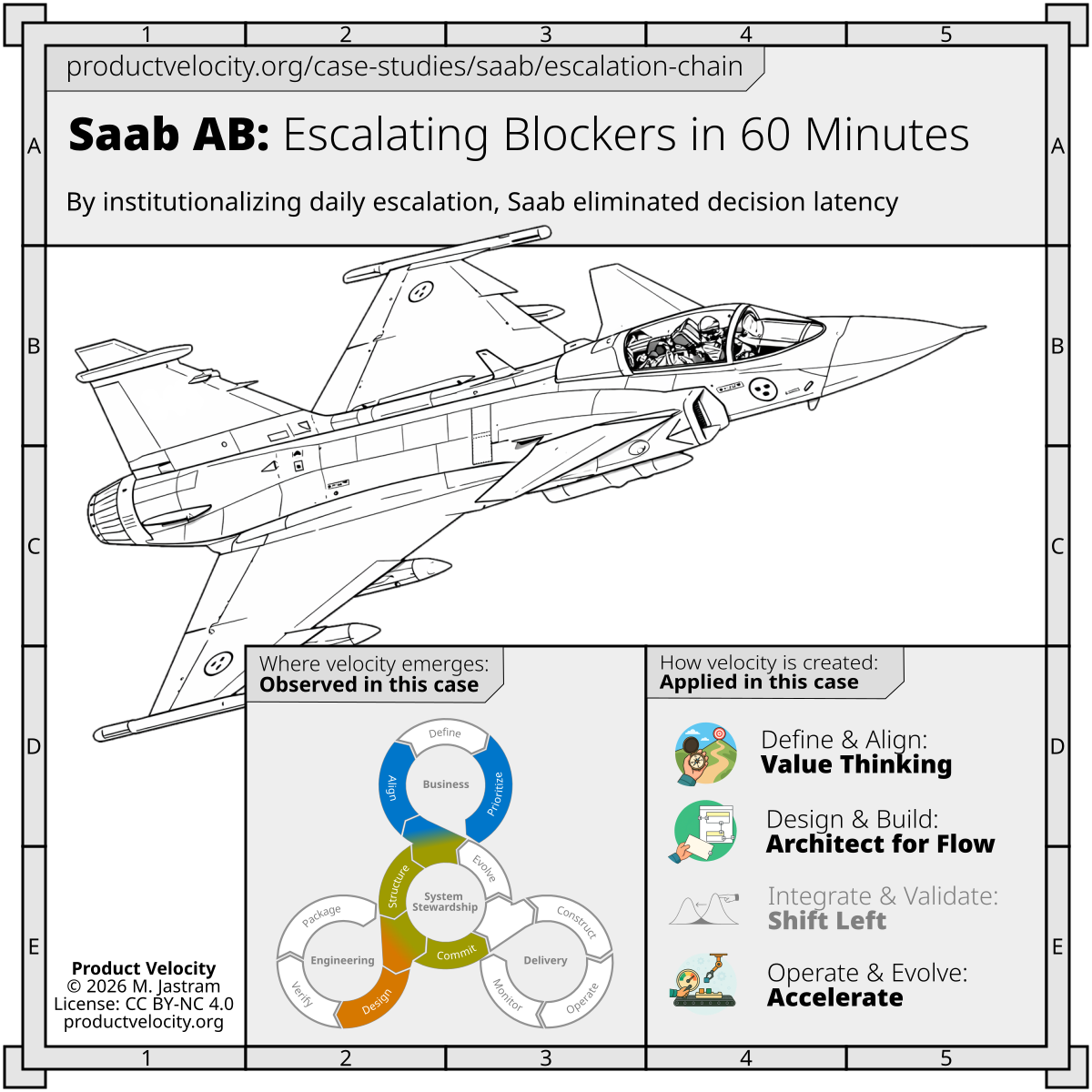
Saab reframed decision speed as an economic variable rather than an administrative concern. Every unresolved blocker represented delayed integration, delayed validation, and ultimately delayed value delivery. Instead of measuring agility through process compliance, Structure leadership focused on flow. Align Executive attention was aligned with removing impediments, recognizing that time lost to waiting compounds across hundreds of teams. Prioritize By treating decision latency as a cost driver, Commit Saab ensured that blocker removal became a strategic priority rather than an operational afterthought.
Architect for Flow
Saab did not rely on informal escalation or heroic intervention. Structure Instead, it deliberately designed a structured escalation architecture. Teams operate in synchronized three-week sprints and quarterly increments, creating shared cadence and transparency. Design Each morning, blockers flow upward through successive synchronization layers, from team standups to Scrum-of-Scrums and finally to an Executive Action Team. Each level attempts resolution immediately. Only if this is not possible, do blockers raise to the next level. This communication architecture minimizes cross-functional waiting time and prevents local optimization from stalling global progress.
Accelerate
Align By institutionalizing daily escalation, if needed to the executive level, Saab compressed decision cycles from weeks or months to hours. Commit Leadership commits time each morning to decide on the handling of unresolved issues, Prioritize making blocker removal a core responsibility rather than an exception. Design This disciplined rhythm keeps design work moving, reduces integration risk, and prevents cascading delays. Speed becomes systemic and organizational friction is surfaced early and eliminated continuously, allowing complex development programs to sustain momentum at scale.
Outcome
Blockers that would traditionally linger in meetings or committee structures are addressed within a single morning. Design flow is protected, cross-team alignment improves, and integration becomes predictable. Saab demonstrates that large-scale agility is not achieved through additional frameworks, but through structural clarity, executive commitment, and ruthless elimination of waiting time.
 English
 German