
Context
Rocket engines are among the most tightly integrated cyberphysical systems. Combustion stability, turbomachinery, cooling, materials, and controls interact in complex, nonlinear ways, and many failure modes surface only during full-power operation. Historically, integrated engine testing was reserved as a rare, expensive milestone. That delayed organizational learning and made each test a political and economic undertaking.
Shift Left
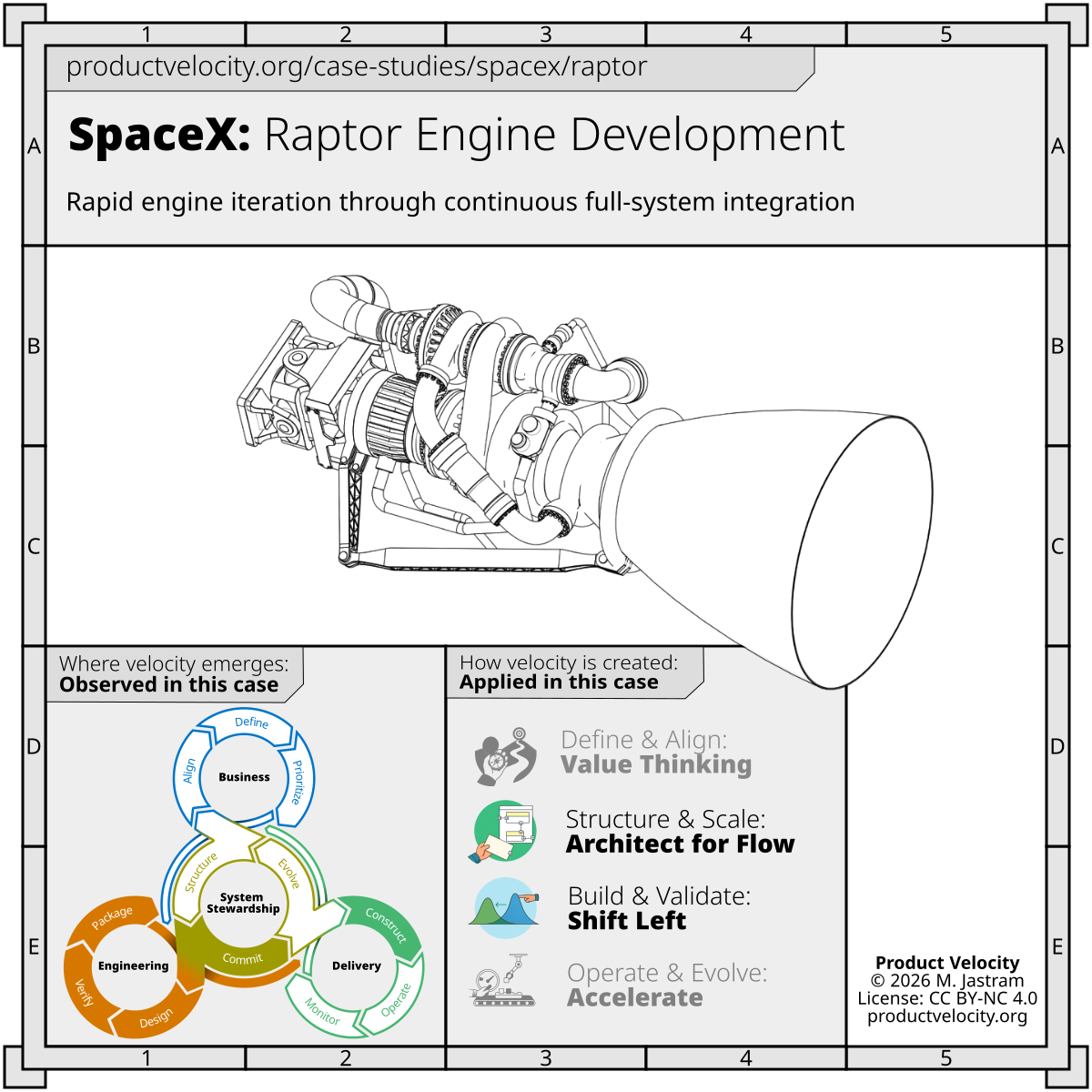
Rather than saving integrated testing for a late milestone, SpaceX moves verification as early and as often as it can. Full engine integration and firing become a routine practice. The company runs the full cycle of design, construction, integration, and test firing for a Raptor engine roughly every two days. It is industrial DevOps applied to cyberphysical hardware. Each test is meant to generate insight, not just confirm assumptions, and failures surface early, as information that feeds the next iteration rather than a late, expensive surprise.
Each cycle feeds the next. Design Engineering designs a change. Construct Delivery then constructs the engine. Verify Engineering fires it on the test stand to verify behavior, and the evidence returns as the input to the next design.
Architect for Flow
A cycle this fast stays cheap only if every engine is always ready to integrate. Package Raptor’s design keeps interfaces and tooling stable, so most changes touch individual components or parameters instead of forcing a full redesign. Each iteration stays integration-ready and can be reintegrated and re-fired at will. That readiness keeps the build-test hand-off direct instead of being gated by rework.
Close the Loop
Commit System Stewardship keeps that stability by maintaining the architectural commitment. It carries a controlled global configuration forward from one iteration to the next, so Delivery’s test evidence maps cleanly back onto Engineering’s design intent. Stewardship establishes that commitment once, and the fast build-test loop then runs against it directly, cycle after cycle, without pulling stewardship back in each time. That is why the hand-off between Engineering and Delivery is both direct and stewardship-anchored at the same time: the commitment is made through the center, and every rapid iteration afterward reuses it on the direct path. Without that anchor, each rapid change would reopen system-level questions and the loop would stall.
Outcome
The benefit extends beyond test frequency. Integrated evidence becomes cheap enough to shape routine engineering choices, and full-system integration turns from an infrequent, high-stakes event into a continuous improvement cycle. Because the architecture stays coherent across iterations, feedback that once took months or years now takes days. Performance and cost improve together, at a pace staged processes cannot match.
 English
 German