
Context
WikiSpeed pursued extreme vehicle development speed after Joe Justice entered the Automotive X Prize challenge in 2006. The goal was to build a road-legal, safe, four-seat car with more than twice the fuel efficiency of a Toyota Prius. The team applied Scrum to hardware, turning regulatory tests, efficiency experiments, and product goals into weekly work. This exposed a bottleneck that traditional specifications did not solve: fast module teams still had to integrate physical parts, loads, heat flows, data, cost limits, and safety constraints.
Architect for Flow
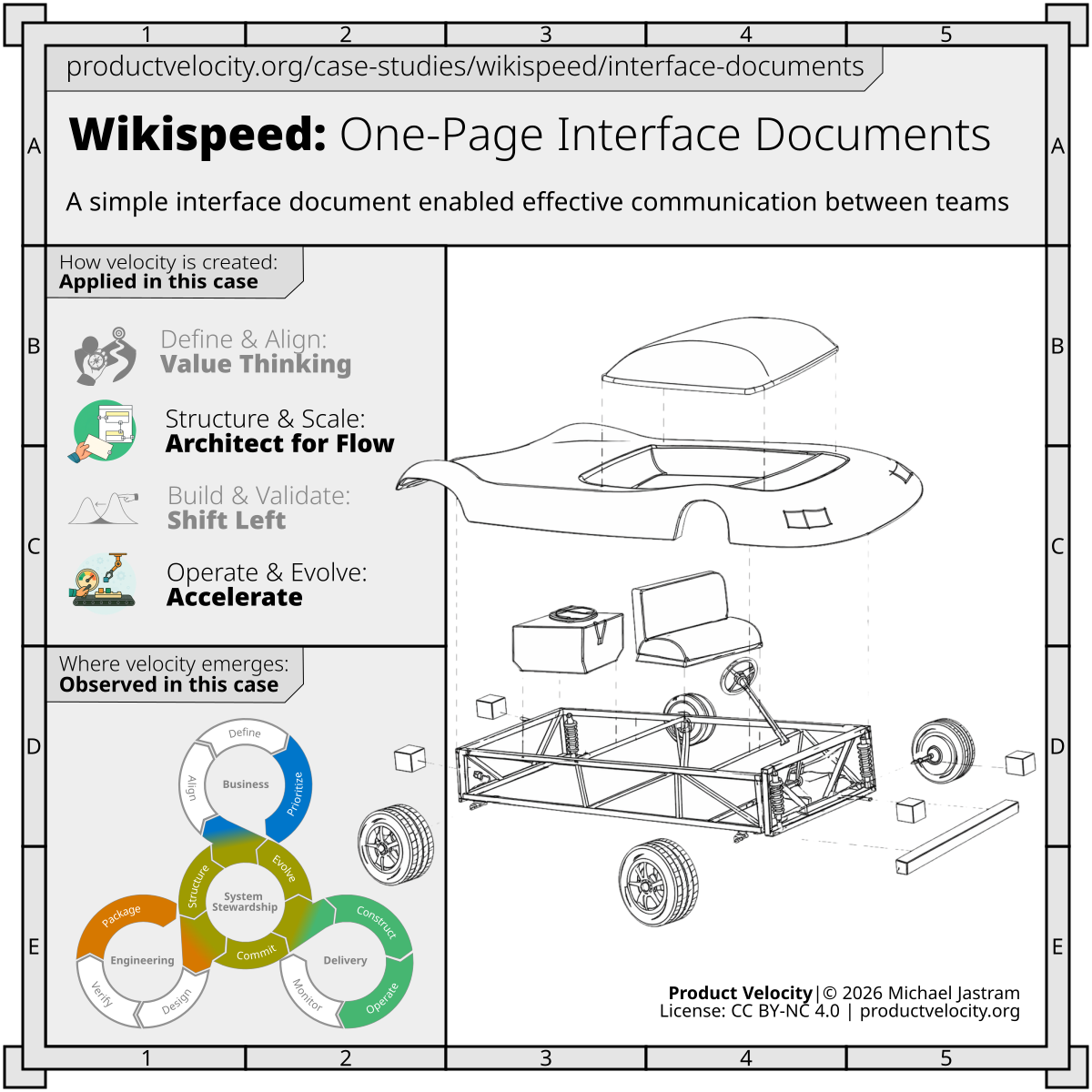
Structure WikiSpeed split the car into a small number of modules owned by independent teams. Each team needed a stable interface before starting a sprint, often represented by a physical stub or the exposed interface of the previous vehicle version. Package Interfaces captured only the constraints other teams needed: geometry, attachment points, loads, heat transfer, data exchange, cost limits, and compliance targets. The interface described what the module had to satisfy, not how the team had to build it.
Commit A module was not done until it connected to its interface and worked with the rest of the vehicle. Construct Integration therefore moved into each team’s definition of done instead of being deferred to a later phase. Interfaces could change as often as once per sprint, but only through Scrum-at-scale coordination among product owners. This kept teams aligned while preserving local freedom.
Accelerate
Prioritize WikiSpeed used one-page enabling specifications to reduce scope to the few constraints that mattered for the whole vehicle. This allowed teams to focus effort and avoid local optimization that would slow integration. Commit Teams committed to stable interfaces for the duration of a sprint, which enabled uninterrupted parallel work.
Construct Each team built and integrated a working module every week as part of a complete vehicle. Integration was not deferred, so issues surfaced immediately. Operate Each sprint produced a functioning car that could be used under real conditions. Evolve Feedback from integration and real-world use fed directly into the next sprint, allowing rapid iteration of both design and production.
Outcome
Explicit, minimal interfaces enabled parallel module development, continuous full-vehicle integration, and weekly delivery of functioning cars. The approach reduced coordination overhead while maintaining system coherence under rapid change. The same principles were later applied by Joe Justice in work with Tesla and SpaceX, extending these practices to high-scale automotive and aerospace systems.
 English
 German