

Context
High-power electronic components at ZF are custom-designed and pushed to extreme thermal and electrical loads. Validating their stress and heat behavior used to rely on heavy physical testing and high-fidelity simulation, and the validation phase alone often ran up to twelve months. With the market demanding shorter cycles, validation had become the dominant bottleneck.
Shift Left
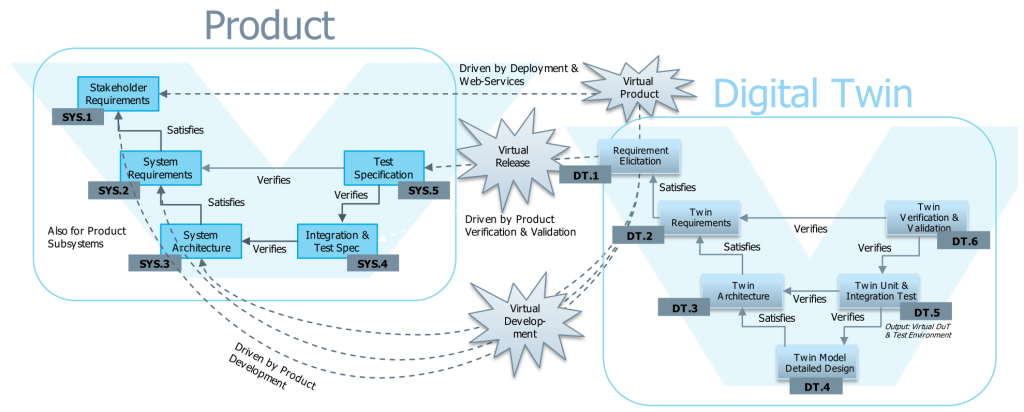
Verify Rather than leave validation as a late, hardware-bound phase, ZF pulled it upstream with virtual V&V built on digital twins. Design The simulation models were not ad-hoc artifacts but developed along the V-model, with explicit requirements and validation evidence. Linking product requirements to model requirements let ZF approve a model early and use it with confidence to validate the design long before a physical prototype existed.
Architect for Flow
To make that practical, ZF built an MBSE tool environment that generates digital twins of the product’s thermal behavior automatically. Structure The system model is the integration backbone, connecting requirements to simulation workflows and results, and AI techniques focus computation on the most critical regions so the twins stay fast enough to use while traceability holds across domains.
Close the Loop
The loop closes because validation stops being a downstream event. Simulation evidence feeds design decisions continuously, and each approved model becomes a reusable asset that the next requirement can lean on, so confidence accrues instead of resetting at every prototype.
Outcome
Validation time fell from twelve months to up to two, which changes the economics of developing high-power electronics. It took years of investment, but the team banked intermediate quick wins along the way, and validation became a continuously improving capability rather than a fixed downstream phase.
Sources
- An MBSE approach for Virtual Verification & Validation of Systems with Digital Twins, Rene Honcak, ZF Friedrichshafen, Ana Wooley, University of Alabama in Huntsville
- Speed through automation – but the right way!
 English
 German