

We usually describe architecture in technical terms, like modularity or reuse. These are important qualities, but they obscure a deeper function: In complex cyber-physical products, architecture defines how the Business loop and the Engineering loop are structurally coupled. It determines how quickly economic intent can influence technical decisions and how quickly technical reality can correct economic assumptions.
In that sense, architecture is not merely a technical asset. It is a financial instrument that governs exposure to uncertainty. This builds on the economic view of flow and cost of delay that Reinertsen established; the focus here is how, in cyber-physical systems, architecture acts as the control surface for that economics.
This is Not Intuitive
This framing feels wrong because architecture and economics live in different conversations. Architecture reviews focus on interfaces, decomposition, and constraints. Executives focus on margin, return on capital, and payback time. The translation between the two is manual and political.
Historically, this separation seemed tolerable: Industrial products evolved slowly, hardware dominated change cost, and long validation cycles were accepted as unavoidable. In today’s software-intensive systems, with asymmetric hardware–software cadences and rising integration complexity, feedback latency becomes the dominant economic risk. Yet it is still rarely engineered explicitly.
The Special Role of Architecture
Architecture determines the speed of economic learning because it defines which parts of the organization can learn independently and which are forced into synchronized change. A tightly coupled system requires coordinated modification across domains before any hypothesis can be validated. A decoupled system allows partial learning. A validation architecture that relies on late physical prototypes locks capital into long cycles. An architecture that embeds trusted virtual verification upstream moves the economic learning boundary earlier. Economic feedback latency is therefore a structural property of the system.
A case from ZF Friedrichshafen AG illustrates this. In developing high-power electronic components, validation had become the bottleneck, with cycles lasting up to twelve months. Rather than optimizing test execution, ZF re-architected where validated knowledge was produced. Requirements were structurally linked to simulation models, and repeatable digital validation workflows were established early in the lifecycle. The result was a relocation of economic learning. Validation time dropped to two months and design alternatives could be evaluated earlier. The architecture of validation changed the economics of development.
Digitalization Reduces Cognitive Translation
If architecture is an economic control surface, then its purpose is to engineer fast, reliable coupling between value intent and technical reality. Digitalization does not increase velocity by automation alone, but by reducing cognitive translation between business, engineering, and delivery, speeding up the traveling of economic signals through the system without distortion or delay. Especially in cyber-physical products, where hardware and software evolve at different speeds, architecture must prevent the slower cadence from dominating the entire learning system.
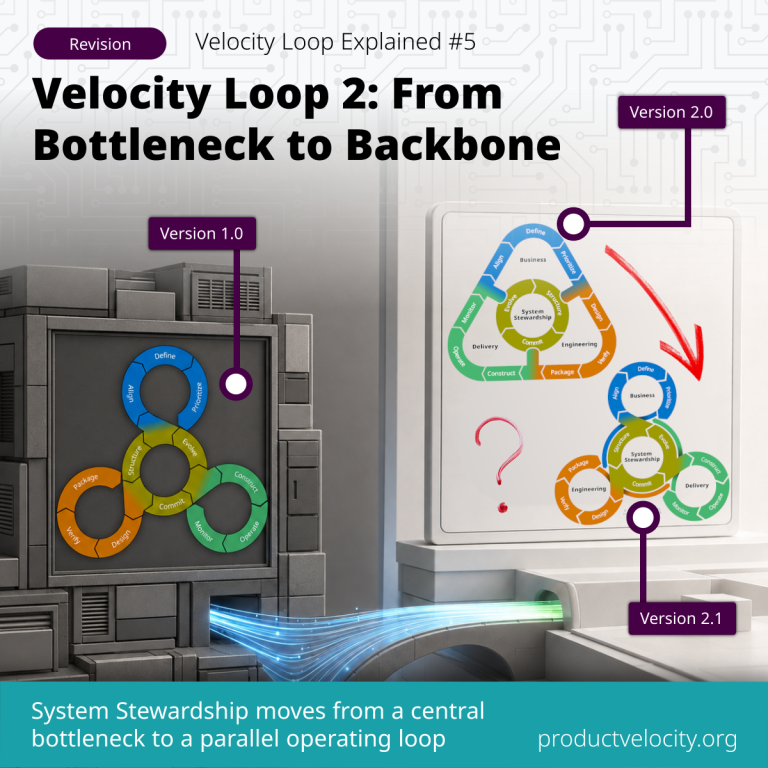
If architecture governs economic feedback speed, then it cannot remain a downstream technical concern. It belongs at the center of strategic decision-making. In Product Velocity, this structural role is captured in the Velocity Loop, the equivalent of the DevOps loop for complex systems. At its center sits System Stewardship, responsible for maintaining architectural integrity as the coupling layer between business, engineering, and delivery. Architecture, in this sense, defines the boundaries of organizational learning.




 English
 German