
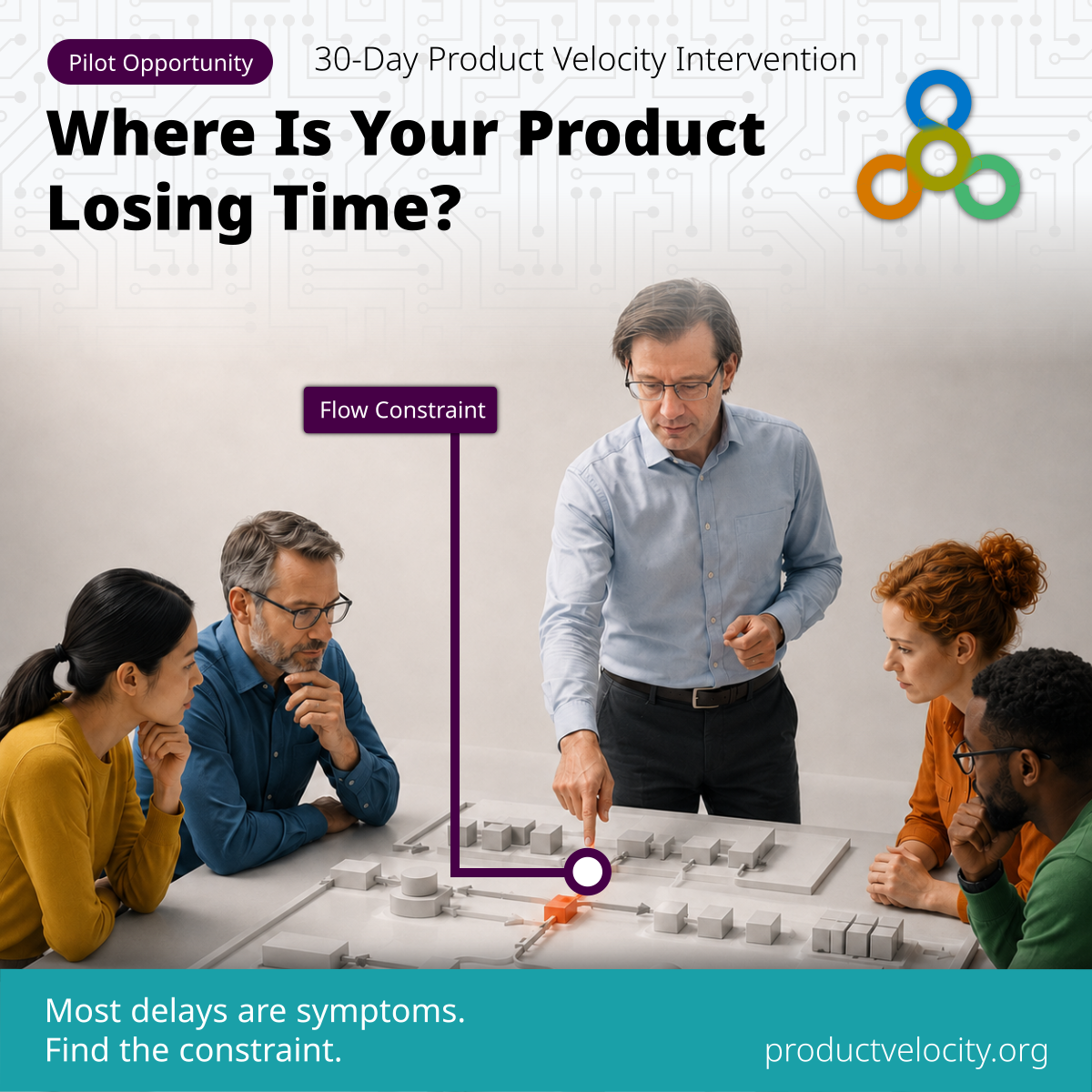
Many companies have Agile, MBSE, DevOps, ASPICE, PLM, ALM and still develop too slowly. I don’t think the missing piece is another method.
The missing piece is usually clarity about where the product loses time. This sounds easier than it is.
Most organizations look at product development through functions, tools, processes, or improvement initiatives. Product Velocity looks at the flow of the product itself: decisions, dependencies, feedback loops, architecture choices, requirements, tests, supplier input, reviews, and rework.
This is why I am opening one reduced-fee pilot slot for a 30-day Product Velocity intervention.
The goal: Identify the strongest current flow constraint in one product development area, run one targeted intervention, and measure its effect after 30 days.
Read on for details. If this already resonates, book a short qualification call.
What problem this addresses
Over the last months, I have run several Product Velocity workshops and discussions. The response has been positive. More important, the same patterns kept appearing.
Teams are busy, but the product does not move fast enough. Requirements exist, but their consequences remain unclear. Architecture exists, but dependencies still surprise people late. Tests are planned, but feedback arrives when design options have already narrowed. Change reviews take time, but do not always reduce uncertainty.
Everyone sees part of the problem. Almost no one owns the flow. That is the gap. The 30-day intervention is designed to make that gap visible and actionable.
What happens during the intervention
We start with one clearly scoped product development area. This can be a product line, subsystem, platform effort, integration stream, change process, test bottleneck, or another area where speed matters.
Then we look at how work actually moves through the system. Where does information wait, where do decisions get delayed? Where does work loop back, where does testing reveal problems too late? And where do teams optimize locally while the product slows down?
The result is a short diagnosis and a concrete intervention proposal.
The diagnosis names the constraint. The proposal describes what should change, who needs to be involved, and what the next step should be.
No maturity score, generic transformation roadmap or 80-slide deck.
The output should be specific enough that the organization can act on it.
A typical example
Many organizations describe testing as the bottleneck. Sometimes that is true.
Often, testing is where upstream problems become visible. The test team then gets blamed for delays created earlier by unclear requirements, unstable interfaces, late supplier input, or immature architecture decisions.
Adding test capacity helps only if test capacity is the constraint. If the real constraint is delayed learning, the intervention must target the feedback loop, not the test department.
That is the type of distinction Product Velocity is meant to make.
Who this is for
This pilot is for organizations developing complex physical or software-intensive products.
It is especially relevant when the company already invests in improvement, but development speed has not changed enough.
It fits situations where the bottleneck sits between functions: requirements and architecture, architecture and implementation, engineering and testing, suppliers and internal teams, or management decisions and technical reality.
However, it is not a fit for a motivational workshop. It is also not a fit when the answer has already been decided and only needs external confirmation.
The intervention only makes sense if there is a real willingness to look at the system and change something concrete.
Why one pilot slot
I work directly on the intervention, so I cannot run several of these in parallel.
For this pilot phase, I am opening one reduced-fee slot. In return, I am looking for a focused case that helps refine the intervention format.
Any external use of lessons learned requires explicit agreement and can be anonymized.
Next step
Book a short qualification call with me. The purpose of the call is to check fit, scope, timing, and whether a 30-day intervention can produce a useful result for your organization.



 English
 German