
Understanding the principles of Product Velocity does not require a transformation program, but conceptual clarity. Once you understand the underlying principles, you begin to see where velocity is unnecessarily constrained, where friction accumulates, and where relatively small structural changes can unlock disproportionate impact. In that sense, understanding the principles often reveals the low-hanging fruit in product development immediately.
This article explains what these principles are, how they differ from other well-known frameworks, how they relate to the Velocity Loop, and how each of them can be applied in practice.
What “Principles” Mean in This Context
Before going into detail, it is important to clarify what is meant by “principles.” A principle can be understood as a fundamental proposition that makes value explicit and guides decision-making across contexts. That is the sense in which the term is used here. You will find it difficult to achieve sustained Product Velocity if you ignore these principles. They operate at a relatively high level and cut across architecture, engineering, organization, and operations. They are not prescriptive methods but orienting mechanisms.
Other influential bodies of work also work with principles. Consider The Principles of Product Development Flow. Reinertsen’s principles are grounded in queueing theory, cost of delay, and economic trade-offs. They are fundamental and powerful, but they operate at a different level of abstraction. In many cases, they function as patterns or decision heuristics to be applied in specific situations, especially where flow economics is the central concern.
Similarly, Industrial DevOps formulates a broader set of principles aimed at lifecycle integration and digital continuity. There is clear overlap, particularly in areas such as feedback loops and system integration. However, Product Velocity condenses what is essential for sustained speed in cyber-physical product development into four cross-cutting principles that shape the entire development system.
In short, the principles of Product Velocity are systemic commitments. They influence how you define success, how you structure architecture, how you validate work, and how you operate products after release.
How the Principles Relate to the Velocity Loop
Organizations often attempt to increase speed through local optimization. They adopt agile rituals, introduce a new tool, automate a pipeline, or pilot artificial intelligence in a specific function. These efforts may yield incremental improvements, but they rarely produce sustained velocity (and sometimes even slow things down). The reason is that speed in complex product development is systemic. It emerges from alignment across the Business, System Stewardship, Engineering, and Delivery loops that together form the Velocity Loop.
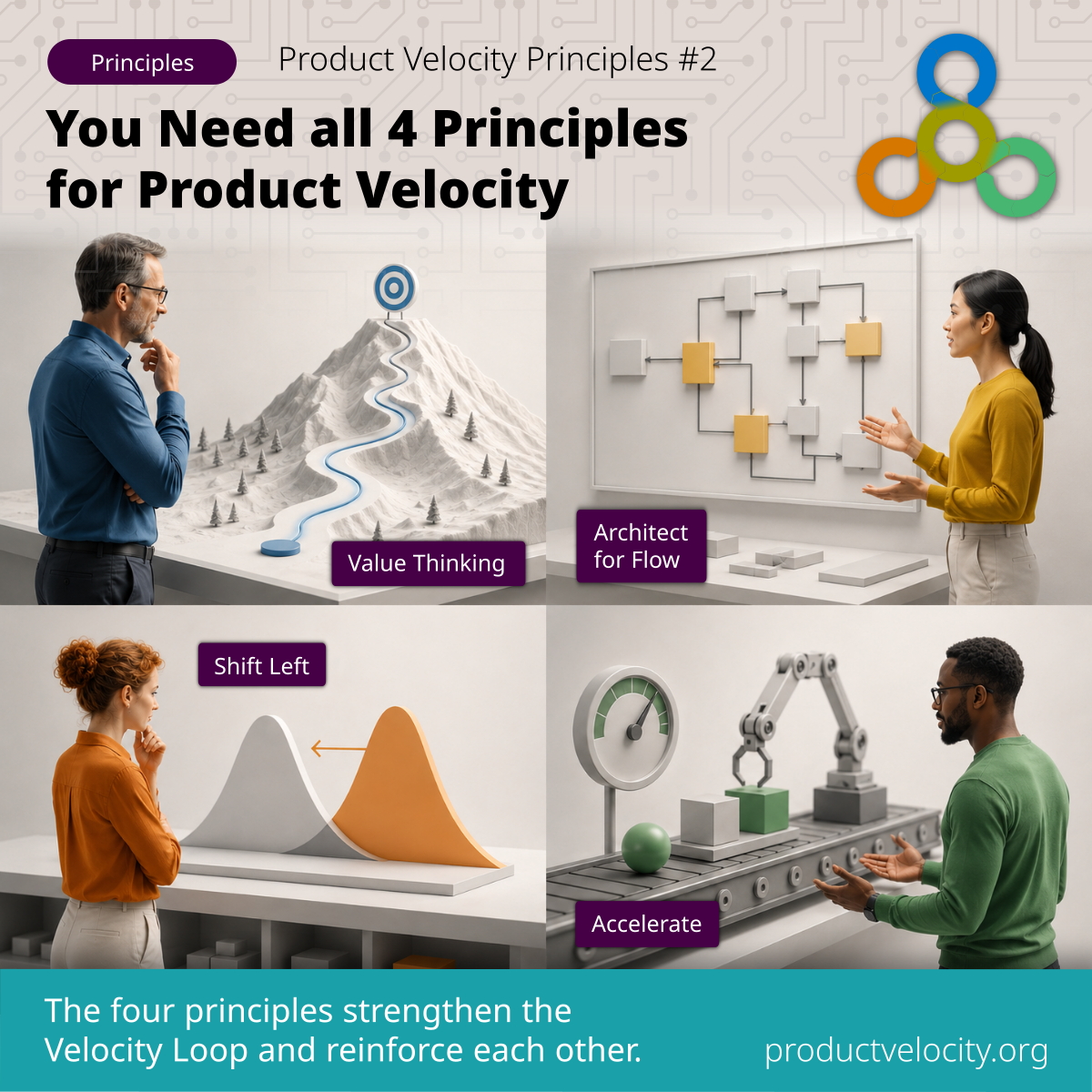
Each of the four principles strengthens specific dynamics within this loop, but more importantly, they reinforce one another. Value Thinking ensures that the Business loop is anchored in measurable outcomes rather than activity. Architecting for Flow stabilizes and scales the System Stewardship loop so that engineering effort compounds instead of fragmenting. Shifting Left tightens the Engineering loop by converting late surprises into early learning. Accelerating connects Delivery back to Business and Architecture, turning release into the beginning of evolution rather than the end of a project.
When one of these principles is neglected, the loop weakens. When all four are applied coherently, velocity becomes a structural property of the organization rather than a heroic effort.
Let’s now look at the four principles, one by one:

1. Value Thinking: Define & Align
In many organizations, velocity is constrained not by technical difficulty but by ambiguity about what truly matters. Teams optimize locally for throughput, feature completeness, or internal milestones, while the underlying value proposition remains implicit. This misalignment generates rework, delays decision-making, and diffuses responsibility.
Value Thinking begins with a simple but demanding commitment: define measurable outcomes and align all relevant actors around them. It requires a continuous refinement of stakeholder needs and an explicit understanding of how each activity contributes to value flow.
Value Thinking strengthens the Business loop by translating stakeholder intent into shared, measurable outcomes and by ensuring that architectural and engineering decisions are evaluated against those outcomes. It is less about prioritization in the narrow sense and more about coherence across the system.
A practical illustration can be found in this Ameru Smart Bin case study. From the outset, the team defined success not as “better accuracy,” but as measurable stakeholder outcomes: disposal convenience had to match conventional bins for users, recyclables lost to waste had to drop significantly for operators, and recycling rates had to increase in a way that justified investment. These explicit KPIs shaped design, AI classification thresholds, and service decisions. Because the team optimized for stakeholder value rather than isolated technical performance, improvements translated directly into economic impact and a credible return on investment.

2. Architect for Flow: Structure & Scale
Architecting for Flow acknowledges that sustained speed is not achieved through improvisation but through structure. It focuses on building a modular and scalable backbone that enables rapid delivery without constant renegotiation between teams.
In cyber-physical systems, architecture determines how quickly change can propagate, how safely experimentation can occur, and how knowledge compounds across product generations. Interfaces, platform strategies, and integrated models are not technical formalities; they are economic instruments. Poorly defined boundaries create coordination overhead and fragile integrations. Clear modularization allows teams to work semi-independently while maintaining system coherence.
This principle primarily strengthens the Architecture loop but has implications across the entire Velocity Loop. When structure is explicit and interfaces are stable, engineering can move faster and delivery becomes less risky.
A useful illustration of Architect for Flow can be found in Wagner’s long-term modeling strategy for safety-critical fire protection systems. Wagner did not attempt a one-time transformation but gradually elevated abstraction levels, strengthened encapsulation, and introduced contract-based design as part of a deliberate architectural direction. Over time, small steps accumulated into a coherent development platform that enabled automation, regression testing, and scalable reuse, ultimately shortening certification cycles significantly. The architectural discipline created a backbone in which flow was embedded in the structure of the system itself.

3. Shift Left: Build & Validate
Shift Left addresses one of the most persistent sources of lost velocity: late discovery. When integration, verification, and validation are deferred, uncertainty accumulates silently until it manifests as delay or crisis.
To Shift Left means to move learning earlier in the lifecycle. This includes continuous integration of software and hardware, early interface simulations, model-based verification, and increasingly AI-assisted analysis of requirements and test artifacts. The objective is not merely to automate existing steps but to structurally reduce the distance between intent and feedback.
This principle tightens the Engineering loop by converting unknowns into validated knowledge at the earliest feasible point. It reduces the cost of change and shortens iteration cycles.
A compelling example of Shift Left can be observed in ZF’s development of high-power electronics, where validation had traditionally been the dominant bottleneck, consuming up to twelve months due to extensive physical testing and computationally intensive simulations. ZF systematically moved verification and validation upstream by establishing model-based Digital Twins. By combining structured modeling with AI-supported model reduction to keep runtimes manageable, ZF transformed validation into a repeatable, confidence-building capability embedded in development flow, ultimately reducing validation time from twelve to two months while maintaining safety and compliance standards.

4. Accelerate: Operate & Evolve
The final principle recognizes that velocity cannot be sustained if development ends at release. Accelerate reframes product development as an ongoing evolutionary process in which operation, feedback, and iteration are tightly coupled.
In traditional models, products are developed, delivered, and then largely frozen until the next major revision. In a Product Velocity environment, release marks the transition into a new phase of learning. Operational telemetry, digital twins, and update mechanisms allow the product to co-evolve with user behavior and environmental conditions.
This principle strengthens the Delivery loop and reconnects it to Business and Architecture. Feedback from the field informs backlog prioritization, architectural evolution, and even platform strategy.
For Saab, Accelerate means institutionalizing rapid decision-making as an operational capability. Saab embedded a daily escalation rhythm that allows blockers to surface and, if necessary, reach executive level within the same morning. Leadership commits time every day to resolve impediments, turning decision latency into an explicitly managed variable rather than an administrative side effect. As a result, issues that would otherwise linger for weeks are resolved within hours, protecting design flow.
How the Book Is Structured
The five parts of the book Product Velocity are organized along these four principles, prepended with another part that establishes the context and provides the proof: why certain organizations achieve sustained speed and how the underlying dynamics work. The subsequent parts are dedicated to Value Thinking, Architecting for Flow, and the combined perspective of Shifting Left and Accelerating. Each part translates the principle into concrete mechanisms, architectural patterns, and case studies drawn from real-world practice.
The structure reflects a deliberate choice. Rather than presenting a collection of techniques, the book builds a coherent argument that velocity is the result of systemic alignment across these four principles.
Conclusion and Outlook
Product Velocity is not achieved through intensity but through structure. The four principles provide a framework for diagnosing friction and identifying leverage points. In many cases, improvement does not require additional resources but clearer alignment, stronger architectural boundaries, earlier validation, or tighter feedback loops.
Understanding the principles enables you to look at your own organization with a different lens. Where are outcomes implicit rather than explicit, or where does architecture create unnecessary coordination overhead? Where does validation occur too late, or where does delivery fail to feed learning back into development?
Addressing even one of these questions can create measurable momentum.
If you would like to follow the development of the book, receive updates on new case studies, or participate in upcoming workshops, consider subscribing to updates and exploring the available resources and case studies. The principles are simple to state, but applying them systematically is where the real work—and the real opportunity—begins.

 English
 German