
Context
Wired Magazine ran a feature on the creation of the Opal nugget ice maker, which is the basis for this case study. It concerns FastWorks, an initative by General Electrics (GE). At the time, GE Appliances was built for scale and new products required multi-year programs, large investments, and forecast-driven decisions. A typical launch depended on internal projections and only reached customers late in the process.
This model struggled with uncertain demand. Large bets locked in cost before value was proven. FastWorks was introduced to change this logic.
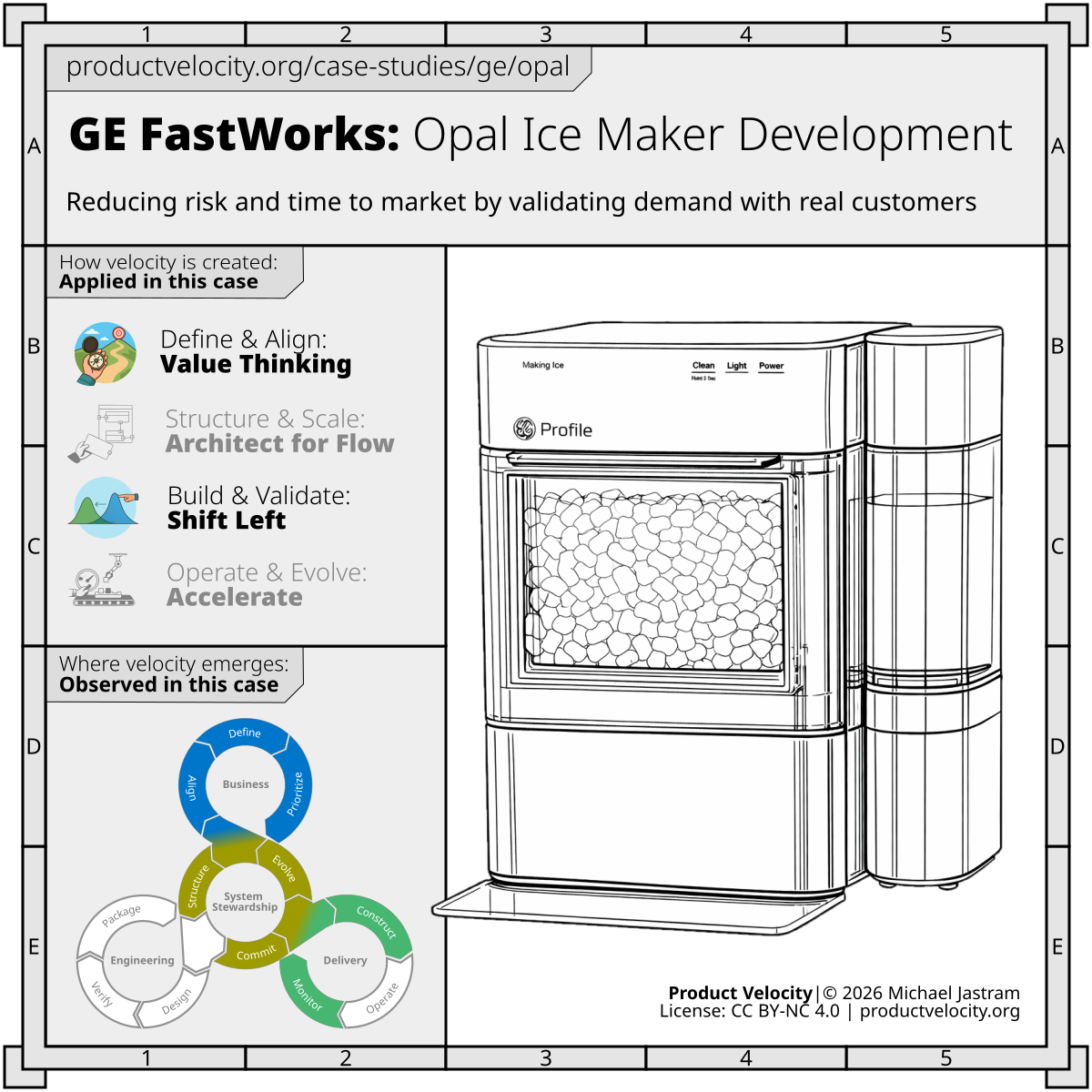
Value Thinking
Align FastWorks replaced internal forecasts with direct market signals. Define Instead of estimating demand, teams asked customers to commit.
The Opal nugget ice maker illustrates this shift. The team launched a crowdfunding campaign with rendered concepts and prototype videos. Monitor Customers paid upfront for a product that did not yet exist. Within months, more than 6,000 backers committed over $2.6 million. Payment before delivery provided hard evidence of willingness to pay.
This approach exposed weak ideas early. Prioritize If customers did not commit, the project stopped. Value was measured through real transactions, instead of predicted by business cases created by analysts.
Shift Left
Evolve FastWorks moved validation to the front of development. Instead of spending years on feasibility and planning, teams built rough prototypes and exposed them early.
Low-cost tools enabled this shift. Construct Desktop PCB machines, laser cutters, and small-scale manufacturing allowed teams to produce functional prototypes, and even saleable small series quickly and cheaply. A product like Opal required about $50,000 to reach market validation.
Structure Development and market testing ran in parallel. Crowdfunding campaigns doubled as experiments. Marketing, engineering, and product definition converged in a single step: would customers pay?
Commit Projects without traction were stopped before scaling. Successful ones transitioned into full production. A traditional water heater program took three years and large investment to reach the market, selling 20,000 units in its first year. Opal reached 6,000 units in 30 days after a development cycle measured in months.
Outcome
Economic exposure shifted from large upfront bets to small, reversible investments. Risk decreased while speed increased. Decision-making changed. Evidence replaced forecasts. Customer behavior replaced internal opinion. Development focused on reducing uncertainty first. Scaling followed validation, not the other way around.
FastWorks did not start with tools or processes. It changed what counted as proof.
 English
 German