
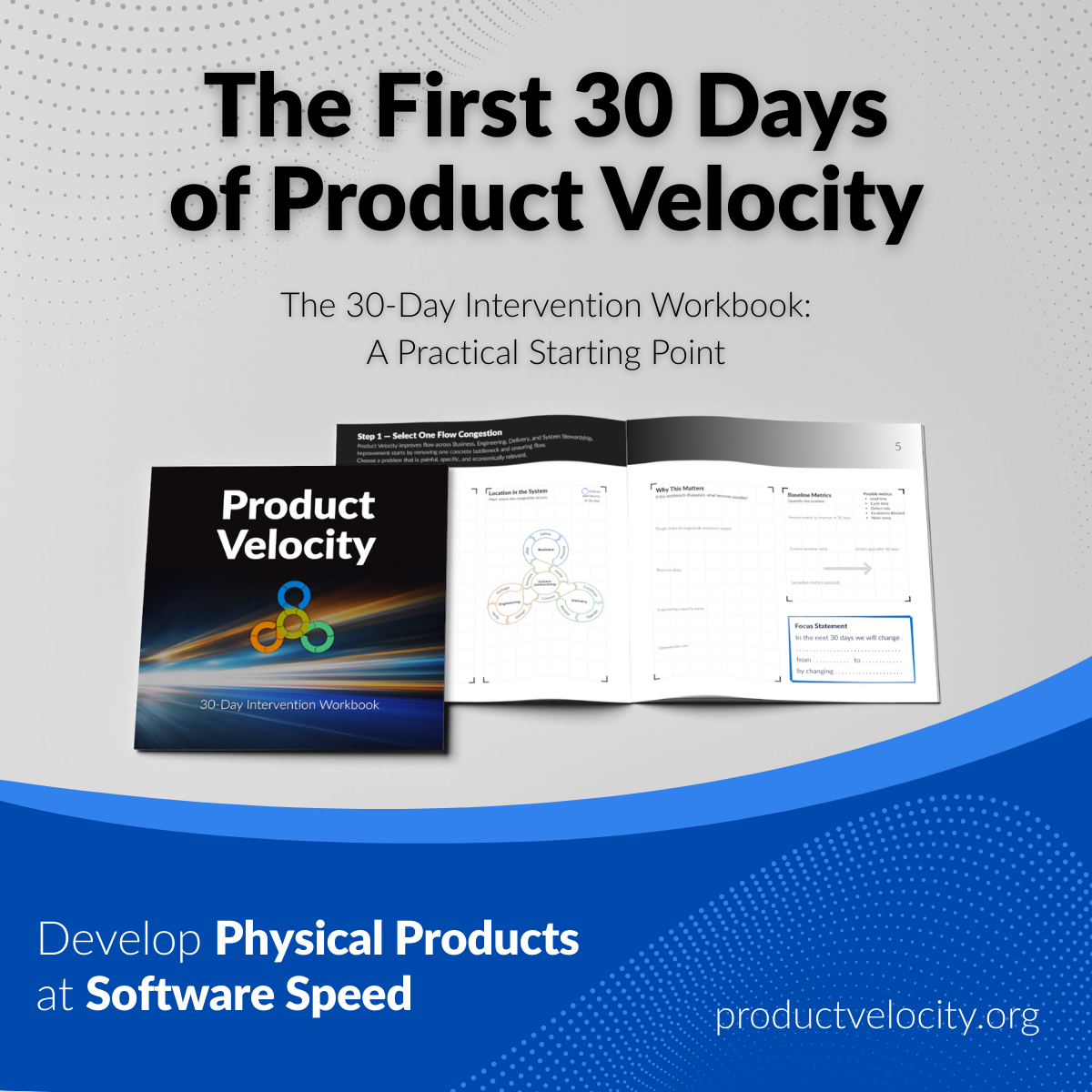
A long journey starts with a single step. A Product Velocity intervention starts with a workshop. It is the foundation for a first intervention that demonstrates success in a short period of time, typically 30 days.
The workshop is the entry point for gaining speed. It does not promise instant transformation, but initiates a 30-day improvement cycle that teams can run themselves or with external support.
Participants leave with a workbook that guides the process. The workbook allows the work to continue inside the organization after the workshop ends.
Why most transformation programs stall
Many transformation initiatives fail before producing visible results, for a number of reaons:
- Local Optimization: Organizations often optimize locally. Individual teams improve their tools or methods. The surrounding system remains unchanged. Improvements do not propagate.
- Long Roadmaps: Large programs rely on long roadmaps. Plans describe a desired future state two or three years ahead. Teams continue working inside the existing system while waiting for the transformation to arrive.
- Ineffective Frameworks: Maturity models reinforce this pattern. They measure conformance against predefined structures. Teams spend time documenting compliance with a framework instead of changing the flow of work.
- Tool Introductions: Tool rollouts create another delay. Organizations purchase platforms and expect process improvements to follow. The underlying coordination problems remain unresolved.
These approaches postpone learning. Product development improves only after teams experiment with the real work.
The intervention starts with a workshop
The workshop serves as the starting point. Participants identify a congestion in the development flow. The problem must be specific and observable. The group analyzes the situation during the workshop. The outcome is a focus statement.
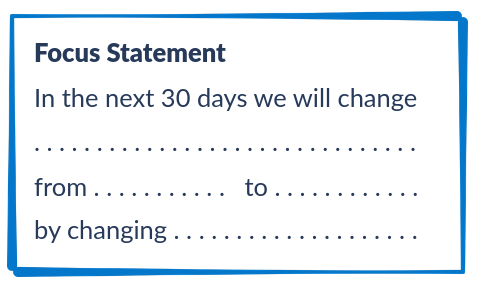
The focus statement defines a concrete change that the team attempts during the next 30 days.
During the following month the team performs four activities:
- Map the local Velocity Loop. Identify where the four principles are violated. Derive possible interventions.
- Identify stakeholders who influence the situation. Secure resources and support.
- Run one targeted intervention in short weekly cycles.
- Measure the effect at the end of the cycle. Evaluate whether the intervention improved flow or feedback.
The goal is not a full transformation. The goal is evidence.
Typical targets
Here are a few Examples that show where teams might start:
- Situation where the Systems Engineering office is ignored: Many organizations create an SE office to introduce architecture practices or MBSE. Project teams bypass the group because it slows delivery or adds documentation. The 30-day sprint focuses on one concrete collaboration point between the SE office and delivery teams. The intervention tests whether architecture guidance can remove a bottleneck instead of creating one.
- OEM requirements exchange via ReqIF: OEM and supplier exchange requirements through ReqIF. Each side maintains different structures and semantics. Engineers spend time reconciling inconsistencies after every import. The sprint concentrates on one interface between the organizations. The team redesigns the exchange rules or validation steps to eliminate recurring rework.
- Manufacturing starts before design stabilizes: A manufacturing organization begins preparing production before the design is validated. Drawings still change, and manufacturing work must be redone. Internal conflicts arise between departments that follow different incentives. The sprint focuses on one feedback connection between design and manufacturing. The intervention establishes a shared decision point that limits rework while maintaining development speed.
What changes after 30 days
The team gains direct experience with the Product Velocity principles. Participants observe where coordination fails across the Velocity Loop: They can put their finger on it on a map that decision makers and practitioners understand. With that, the organization obtains concrete data about a real bottleneck.
At the end, leadership sees evidence from an operational experiment rather than from reports or presentations. The results are quantified using metrics established and measured at the beginning of the initiative.
The team finishes the cycle with a documented outcome and a clearer target for the next intervention.
After the workshop: with external help or without?
Many teams like external support during the 30 days of the implementation. It helps to have an external expert to provide an outside perspective. The level of involvement can vary from a few short touchpoints, to permanent placement in the team.
But external help is optional. Other teams prefer to use the results from the workshop on their own, which is perfectly fine.
Either way, it’s important to implement the decisions from the workshop right away, to prevent going back to “business as usual”. Teams are usually surprised at what they can achieve in just 30 days. But even if the desired goals do not manifest as hoped, the intervention represents a structured learning experience that proofs (or disproofs) a hypothesis.
Why this works
Product development systems contain both operational and structural constraints.
Bottom-up interventions expose the operational constraints. Teams remove a bottleneck and demonstrate measurable improvement.
These visible results create momentum. Leadership gains confidence to address structural constraints.
The Velocity Loop provides a shared language across business, system stewardship, engineering, and delivery. It exposes disconnects between practices and responsibilities.
The largest improvements appear at these interfaces.
 English
 German